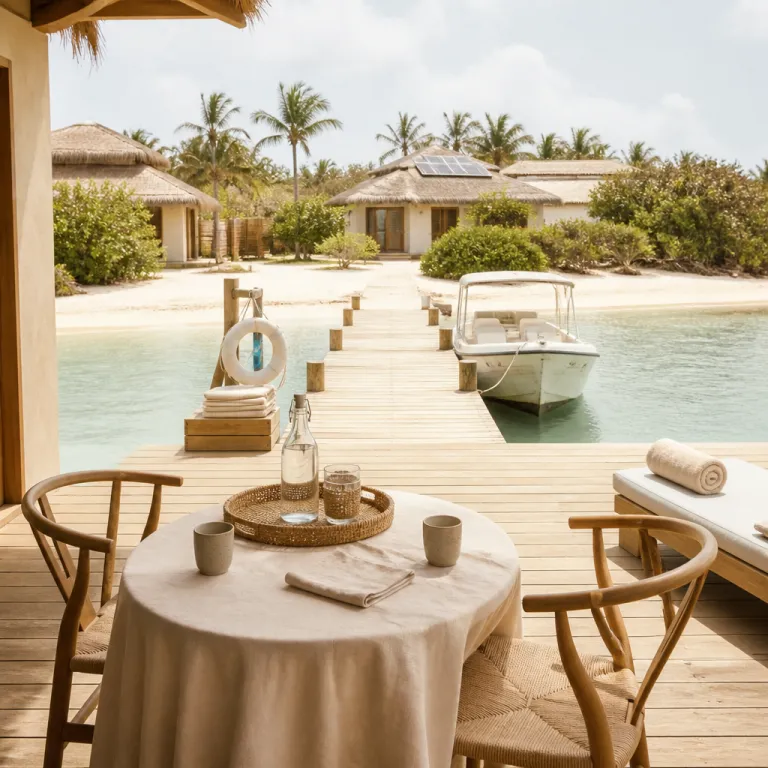
Private island hotel experience: what to expect beyond the dream shot
The private island hotel experience what to expect often begins long before you see the sand. Your first real contact with the island will usually be the transfer, and that journey quietly sets the tone for everything that follows. For many guests, this is the moment when the glossy brochure becomes a lived experience and the main content of the trip truly starts.
Most high end island resorts arrange either a speedboat, seaplane or helicopter, and each option offers a different rhythm. A seaplane transfer feels cinematic and slow, giving you time to enjoy the shifting colours of the reef while you fly low over the water, yet it is also the most weather dependent and the first to be cancelled when storms roll in. A fast boat is usually cheaper and more flexible, but on open water a rough day will turn the crossing into a test of your sea legs rather than a gentle prelude to luxury.
Before you book any private island stay, ask the hotel for hard facts about transfer duration, typical cancellation rates and back up plans. Some islands are only reachable during daylight hours, which means a delayed international flight can strand you on the mainland for a night and change what you expect from your carefully planned arrival. When a resort offers a helicopter option, clarify luggage limits and extra costs, because the sleek ten minute hop can quietly add four figures to a family travel budget.
From an operational perspective, the island offers a self contained ecosystem where every crate of produce, every bottle of wine and every spa product must arrive by boat or plane. This logistics chain is why the average nightly rate for a serious five star private island resort often sits around 1 500 USD, with occupancy levels that can reach eighty five percent in peak seasons according to recent hospitality reports. Understanding this context helps guests find realistic value in the price of seclusion, rather than assuming that every high rate automatically guarantees a flawless luxury experience.
Seclusion versus limitation: when isolation shapes your stay
Once you land, the first impression is usually silence, broken only by surf and palms. You are surrounded by water on all sides, and that physical separation from the mainland is the defining feature of any private island hotel experience what to expect. For some guests this feels like freedom, while for others it quickly reveals itself as limitation.
Connectivity is the most obvious trade off, because many island resorts intentionally keep Wi Fi speeds modest to encourage a digital detox. One verified guidance from operators is clear : "Is Wi-Fi available?" and the honest answer remains "Often limited or unavailable to promote disconnection." If you rely on stable connections for remote work, medical teleconsultations or simply to keep teenagers entertained after dark, you will need to calibrate what you expect from this kind of escape.
Medical access is another under discussed aspect of what to expect from a private island, especially for families or older guests. Most serious five star properties maintain basic first aid, defibrillators and staff trained in emergency response, yet the nearest fully equipped clinic may still be a thirty to sixty minute boat ride away on a calm day. If safety is a priority for you or your family, ask the hotel to outline evacuation procedures, typical response times and whether the island offers on site medical staff during the night.
Entertainment and dining variety also shift when the island is the hotel and there is no neighbouring village to wander into after dinner. A well run resort offers variety through rotating menus, themed nights and flexible dining locations, but you should not expect the endless restaurant choice of a mainland coastal city or a destination like South Padre, where elevated beachfront escapes in villa rentals allow you to step out into local bars and cafés. On a private island, the bar you drink at on the first evening will probably be the same bar you return to on the fifth, so consider whether that rhythm suits your personal travel style.
Weather dependency and the art of being stuck on an island
Weather shapes every private island hotel experience what to expect, far more than at a mainland beach resort. When the sea turns rough or low clouds roll in, seaplanes are grounded, boats slow down and your departure or arrival can shift by hours or even days. This is not a theoretical risk but a structural reality of island travel that every guest should understand before booking.
During stormy periods, the island offers a different kind of luxury, one that is less about sun loungers and more about shelter and calm. A thoughtful hotel will communicate clearly about contingency plans, explaining whether guests can extend their stay at a reduced rate if transfers are cancelled, or whether they will help arrange mainland accommodation if you cannot reach the island on schedule. Ask in advance how the resort handles non refundable bookings when weather makes travel impossible, because policies vary widely even among five star properties.
Once you are on the island, a rainy day does not have to feel like a lost day if the resort offers variety in its indoor spaces. Some properties design generous libraries, cooking classes, spa rituals and marine talks that turn bad weather into a different kind of experience rather than a disappointment. Others rely almost entirely on the beach and pool, which means that several grey days in a row will quickly expose a lack of depth in the main content of their guest programming.
Seasonality matters as much as daily forecasts, and serious travellers should study wind patterns, monsoon windows and cyclone risks for the region they choose. In French Polynesia, for example, the elegant beachfront escapes on Moorea balance lagoon calm with mountain shelter, while more exposed atolls can feel raw and wind blasted outside the driest months. When you compare options, ask each island resort to explain not just average sunshine hours but also how often transfers are disrupted, because that is the statistic that will most directly affect what you actually experience.
Life on a self contained island: rhythm, routine and real luxury
On a private island, the resort is not just where you sleep, it is the entire world you inhabit. The best properties understand that the island offers a complete ecosystem, and they design each path, jetty and viewpoint to create a sense of gentle exploration. Your day quickly falls into a rhythm shaped by tides, light and the sound of the surf rather than by city clocks.
Mornings often begin early, when the air is still cool and the beach is empty except for staff quietly raking the sand. This is the time when guests who value privacy and calm will enjoy long swims, reef snorkelling or paddleboarding around the headland, returning to find breakfast laid out with tropical fruit and strong coffee. As the sun climbs higher, the focus shifts to shade, spa treatments and slow lunches, because the midday heat on a small island can feel more intense than on a breezy mainland coast.
Afternoons bring a different energy, especially if the resort offers variety in its activities program. You might join a guided reef walk with the marine biologist, learn to cook local dishes with the kitchen équipe or take a boat to a sandbank for sunset drinks, all of which turn the private island hotel experience what to expect into something more layered than just lying by the pool. When the island is small, these curated experiences are what keep the day feeling expansive rather than repetitive.
After dark, the isolation becomes more pronounced, and this is where expectations need to be honest. Nightlife usually means a quiet bar, perhaps live acoustic music and a sky dense with stars, not a club scene or late night shopping. If you crave multiple bars, street food and spontaneous detours, you may be happier on a sophisticated mainland coastline such as Portugal’s Silver Coast, where luxury seaside hotels place you steps from both the Atlantic and local neighbourhood life.
Service, staff dynamics and the human side of island luxury
Because a private island is a closed environment, staff dynamics feel different from those at a large city hotel. Teams tend to be smaller and more stable, which means the same faces greet you at breakfast, guide your snorkelling trip and remember how you take your coffee. Over a few days, this continuity creates a level of personalised service that many guests quietly rank above marble lobbies or oversized pools when they recall their stay.
From an operational standpoint, living and working on an island requires commitment from the staff, who often spend weeks away from their own families to look after yours. This reality shapes the atmosphere in subtle ways, because a motivated équipe that feels valued will naturally extend that care to guests, while a tired team on long rotations can make even a five star resort feel flat. When you read reviews, pay attention to how often guests mention individual names, as this is a reliable indicator of whether the human side of the private island hotel experience what to expect is thriving.
Privacy is another dimension where island service differs from mainland hospitality. With fewer rooms and more space, staff can usually anticipate when you want interaction and when you prefer to be left alone, arranging private dinners on the beach or quiet turndown services without fuss. At the same time, anonymity is limited, because everyone quickly knows which villa you occupy and which activities you have booked, so consider whether this level of gentle visibility aligns with what you expect from your travel style.
For families, the combination of attentive staff and contained geography can feel reassuring, as children can roam within clear boundaries while adults relax. Safety protocols are typically strong, with lifeguards on key beaches, clear signage around currents and staff trained to manage marine risks, yet parents should still ask direct questions about supervision ratios and emergency drills. In the end, the most memorable luxury on a private island often comes from these human interactions, not just from the hardware of villas and pools.
Who a private island truly suits – and who should stay coastal
Not every traveller is wired for the same kind of isolation, and that is where expectations need to be brutally honest. The archetypal guest who thrives on a private island is the solo explorer or couple who values quiet, routine and the ability to disconnect without feeling deprived. If you are content with a few well chosen experiences each day and long stretches of unstructured time, the private island hotel experience what to expect will probably feel like a rare luxury.
By contrast, restless travellers who draw energy from urban density, spontaneous restaurant hopping and late night culture may find the island offers too little external stimulation after the initial novelty fades. For them, a high end beachfront hotel on a lively coast, with day trips to nearby islands, can deliver a better balance between seclusion and variety. This hybrid model lets you enjoy private coves and boat excursions by day, then return to a town where you can skip main tourist traps and still find local bars, galleries and street life after dark.
Families need to think carefully about how their children handle routine and repetition. A well designed resort offers variety through kids’ clubs, marine activities and cultural workshops, but the physical boundaries of a small island mean that playgrounds, pools and beaches will repeat across the stay, which some children love and others resist. If your family thrives on new parks, markets and urban adventures every day, a coastal base with flexible excursions may be a better fit than a fully private island.
Ultimately, the decision comes down to how you define value in travel. If you measure a trip by the number of restaurants tried and neighbourhoods explored, a private island will always feel narrow no matter how many stars the resort claims. If you measure it by depth of rest, quality of light, the sound of waves at night and the rare feeling of being truly surrounded by sea and sky, then this is where the aerial photography finally matches the reality beneath your bare feet.
Key figures and practical statistics for private island stays
- Average nightly rates for high end private island resorts cluster around 1 500 USD per room, reflecting the cost of logistics and low room counts, according to Luxury Travel Magazine.
- Occupancy rates on successful private islands can reach approximately 85 percent in peak seasons, a figure reported by recent Hospitality Industry Reports that underlines strong demand for secluded stays.
- Transfers by seaplane are among the most weather sensitive options, with operators in regions like the Maldives and Seychelles reporting significantly higher cancellation rates during monsoon months compared with speedboat services.
- Many private island properties now integrate eco friendly initiatives such as solar power, desalination and reef conservation programs, aligning with global sustainability targets tracked by organisations like the United Nations World Tourism Organization.
- Guest surveys from luxury travel agencies consistently show that privacy, personalised service and access to a quiet beach rank as the top three reasons travellers choose a private island over a mainland coastal hotel.
FAQ about private island hotel realities
What amenities are typically offered on a private island hotel?
Most serious private island resorts provide direct access to a quiet beach, gourmet dining with a focus on local produce and full service spas offering massages, facials and wellness rituals. Many also include non motorised water sports such as kayaking, paddleboarding and snorkelling equipment in the room rate. Higher end properties may add private pools, butler service and curated excursions like sandbank picnics or sunset cruises.
How do I usually reach a private island hotel safely ?
Access is typically arranged by the hotel through either a speedboat, seaplane or occasionally a helicopter, depending on distance from the mainland and local infrastructure. Guests should confirm transfer times, luggage limits and potential weather disruptions before booking international flights. For safety, ask whether life jackets, trained crew and backup vessels are standard on all crossings.
Is Wi Fi and mobile connectivity reliable on private islands ?
Connectivity on private islands is often deliberately limited to encourage guests to disconnect from constant notifications. Many properties provide Wi Fi in public areas and sometimes in rooms, but speeds can be slower and outages more frequent than in cities. If you need to work remotely or manage critical communications, confirm coverage maps and backup options with the hotel in advance.
Are private island stays suitable for families with children ?
Private islands can be excellent for families who value safety, contained spaces and nature based activities such as snorkelling, shell collecting and guided wildlife walks. Parents should check whether the resort offers supervised kids’ clubs, child friendly menus and medical support on site or nearby. For very active or easily bored children, a larger coastal destination with more varied off property excursions may work better.
How far in advance should I book a private island resort ?
Because many private islands have relatively few villas or suites, peak dates such as festive periods and school holidays can sell out many months in advance. Booking at least six to nine months ahead is sensible for popular regions like the Maldives, Seychelles or French Polynesia, especially if you need specific room categories. Shoulder seasons often offer better availability and more flexible cancellation policies, which can be valuable given weather related uncertainties.
References
- Luxury Travel Magazine
- Hospitality Industry Report
- United Nations World Tourism Organization